
🎉 Early Bird — 30% off all plans — Ends in 8d 03h 16m 02s · Code: EARLYBIRD30 Get the discount →

How to Make WordPress Search Inside PDF Files (2026 Guide)

How to Make WordPress Search Inside PDF Files (2026 Guide)

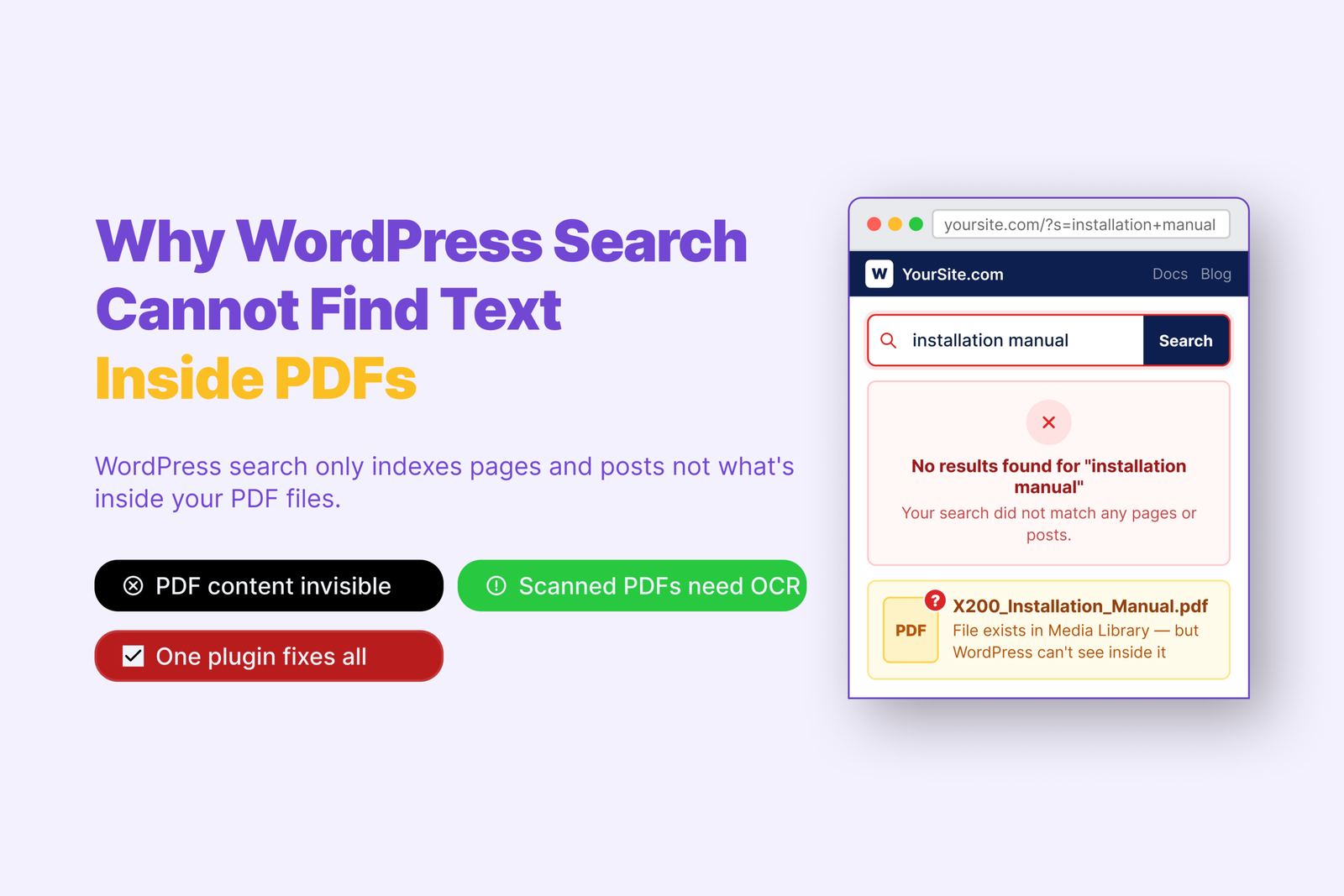
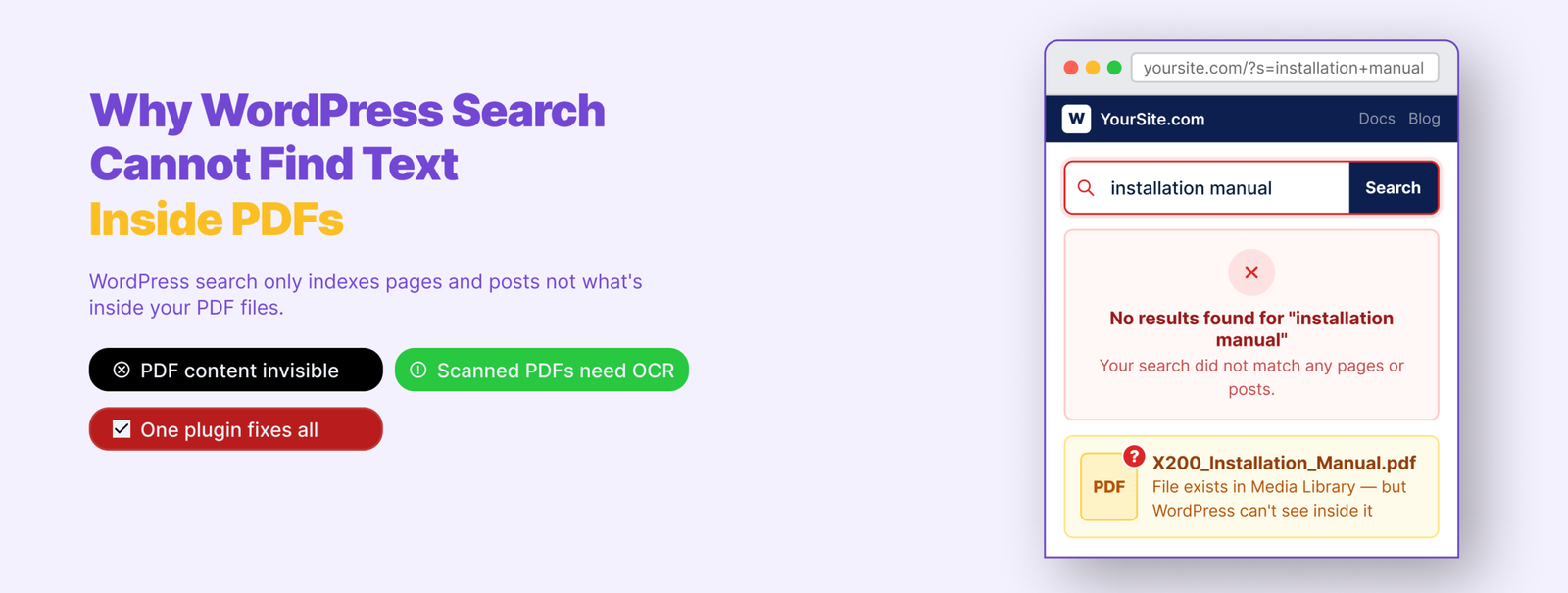
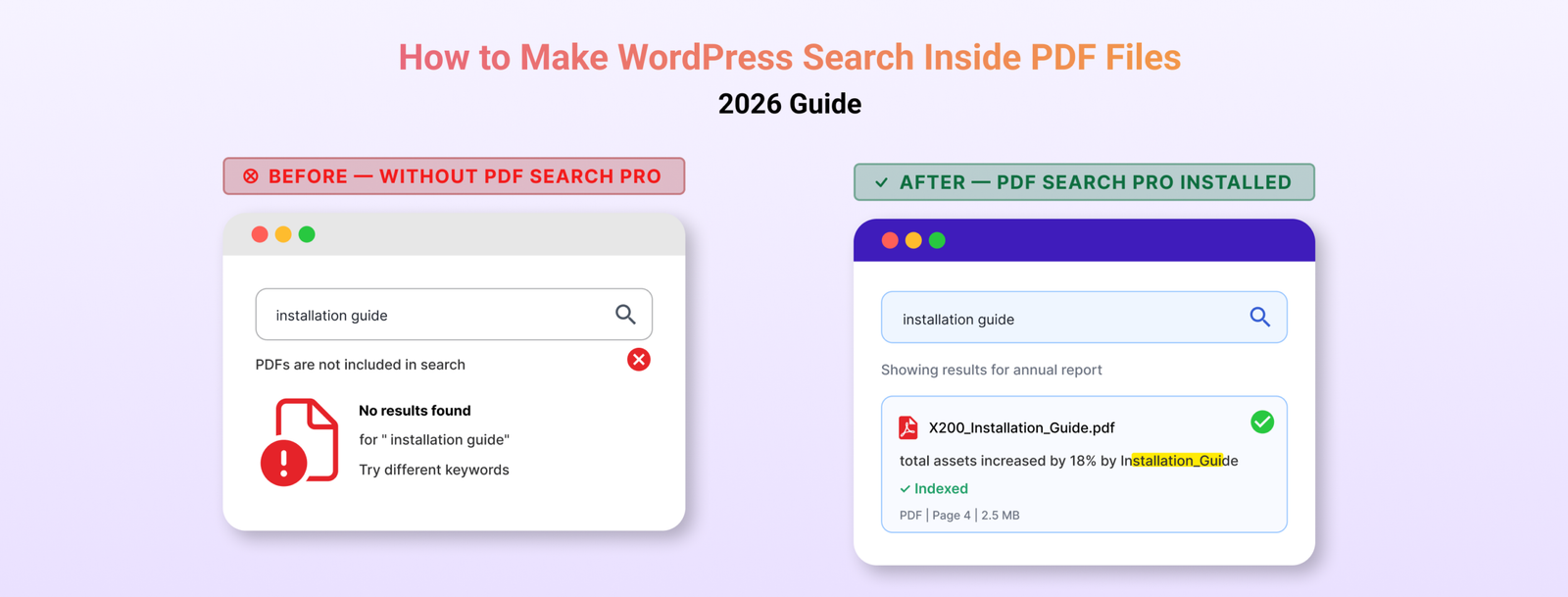
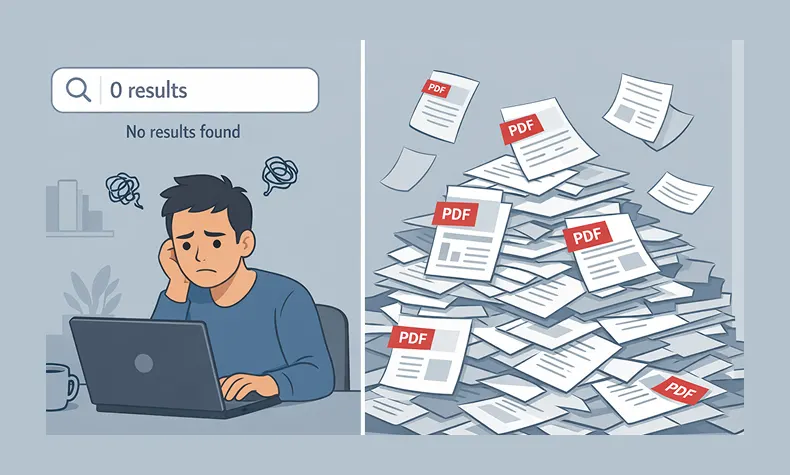
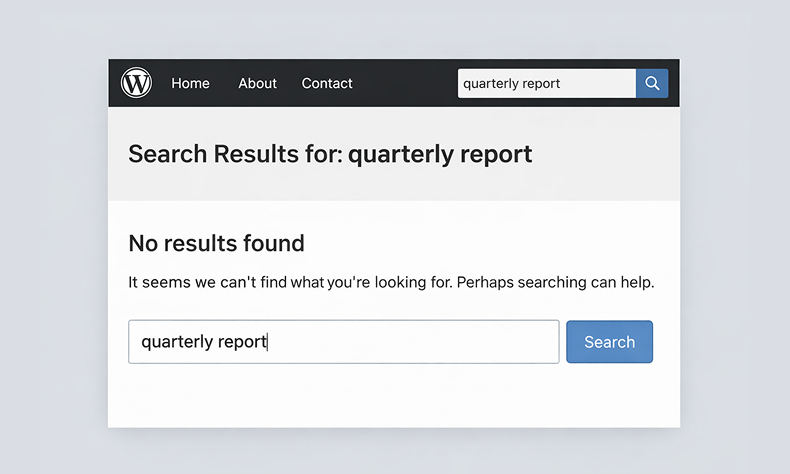
You upload a PDF to WordPress. A visitor comes to your site, searches for something they know is in that document — and gets nothing back.
No results. The file is sitting right there in your Media Library. The answer they need is on page three. WordPress just has no idea it exists.
We hear this constantly from site owners. People who’ve done everything right — uploaded their documents, organised their library, built a decent site — and still can’t figure out why search ignores their PDFs entirely.
The reason is straightforward once you know it. And so is the fix. Here’s both.

Why WordPress Search Ignores PDF Content

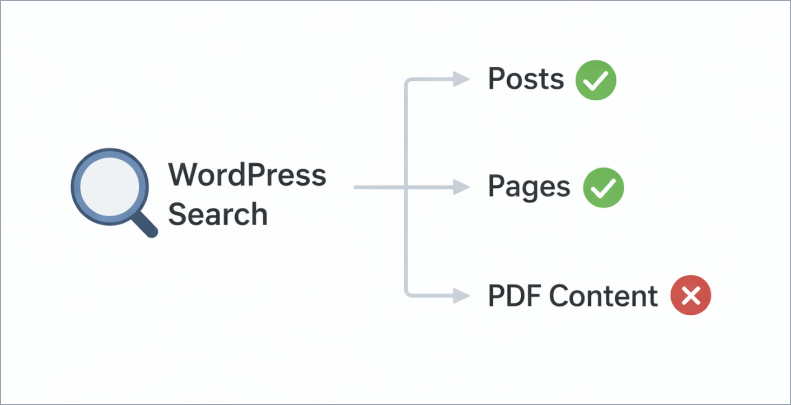
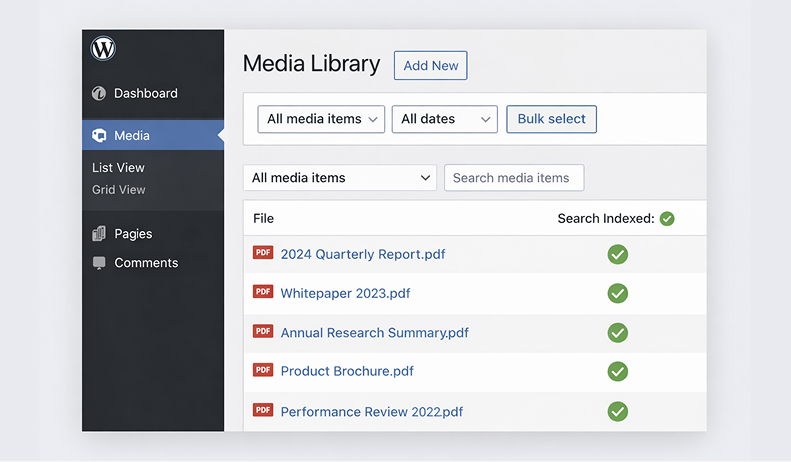
WordPress search works by looking at your posts and pages — the content you type directly into the editor. When you upload a PDF, WordPress stores the filename, a URL, and some basic file details. That’s all.

It never opens the file. It never reads what’s inside.

So when someone searches your site for “refund policy” or “installation guide” or “chapter three” — and those words only exist inside a PDF — WordPress comes back empty-handed. Not because the content isn’t there, but because it was never told to look inside PDF files.

This isn’t a bug. It’s just a gap that WordPress was never designed to fill.

What You Actually Need

To make WordPress search inside PDF files, you need a plugin that does two things.

First, it needs to extract the text from your PDFs. This means actually opening each file and reading the words inside — something WordPress doesn’t do on its own.

Second, it needs to store that text in a searchable index so that when someone types a query, it can match against that content.

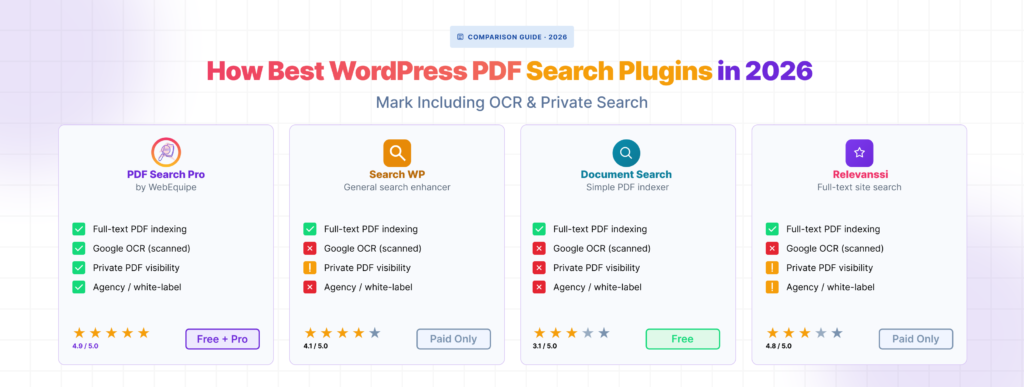
A PDF search plugin fills that gap. There are a few options out there, but the simplest purpose-built one for WordPress is WebEquipe PDF Search. The free version handles standard PDFs and gets them into WordPress search in a few minutes. The Pro version adds OCR for scanned documents and private search for member-only content — more on those at the end.

Before You Start — Check Your PDFs

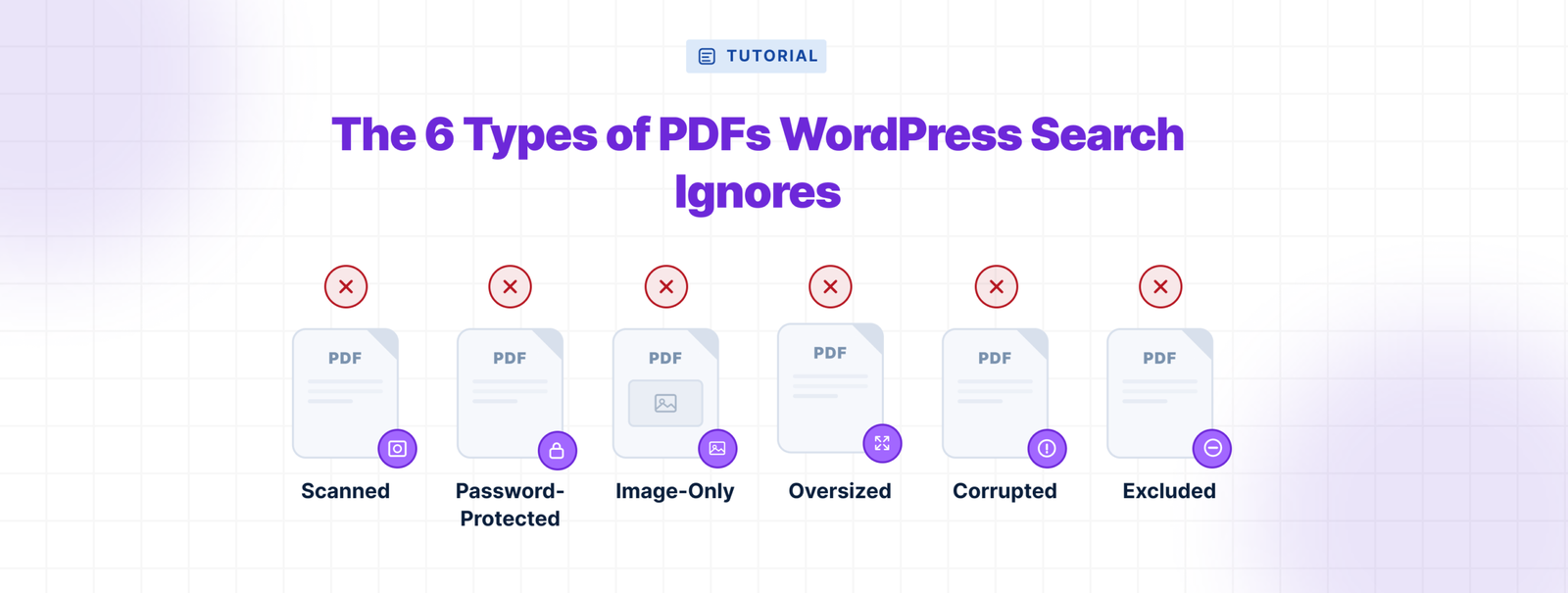
Not all PDFs are the same, and this matters before you install anything.

Text-based PDFs are documents created digitally — exported from Word, Google Docs, InDesign, or any document editor. These contain an actual text layer. A PDF search plugin can read them without any issues.

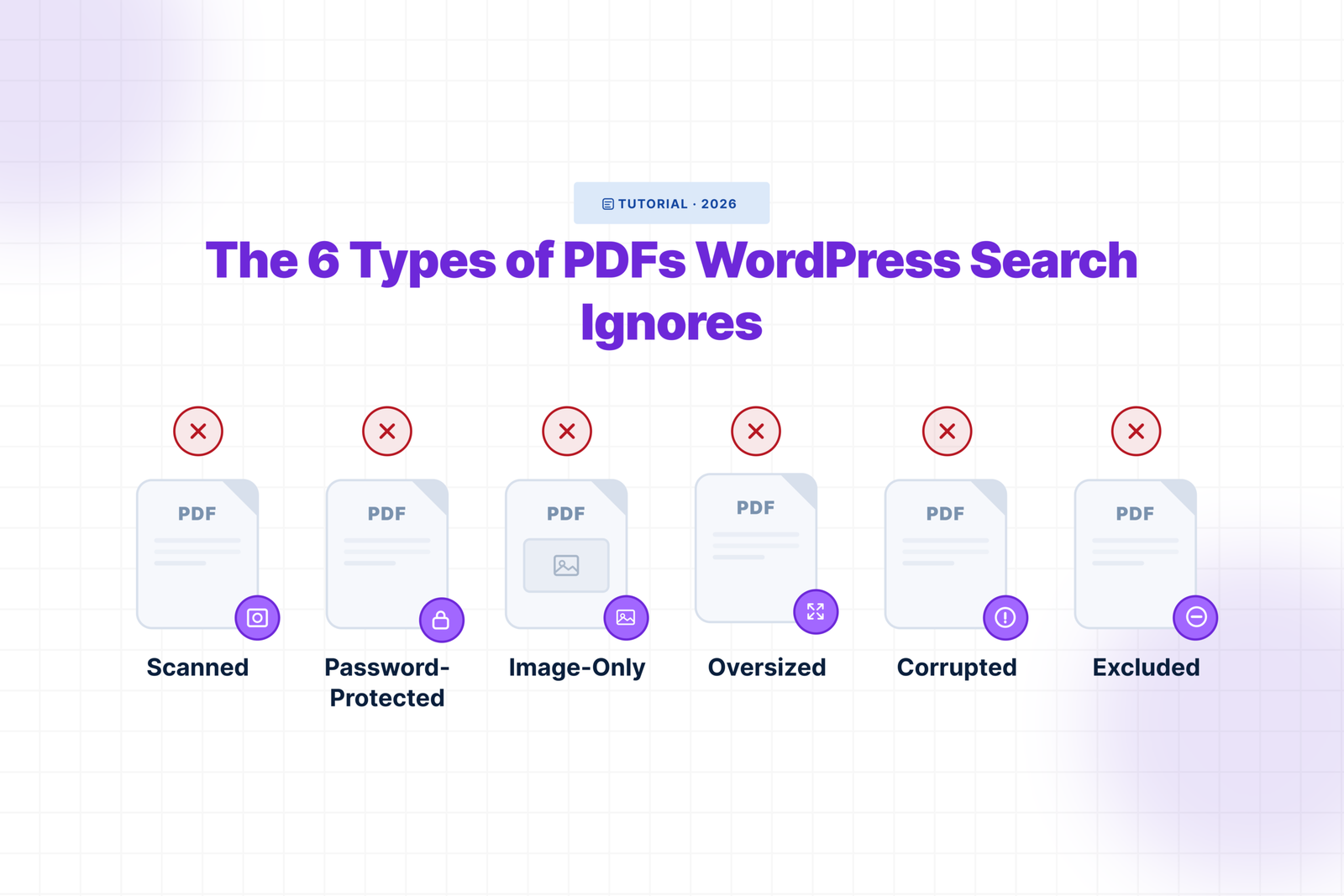
Scanned PDFs are photos of physical pages. Someone put a piece of paper on a scanner and saved the image as a PDF. There’s no text layer — just pixels. A standard PDF search plugin can’t read these.

How to tell the difference: open the PDF in your browser and try to highlight some text. If you can click and drag to select words, it’s text-based. If clicking just draws a box with nothing selected, it’s scanned.

The free plugin handles text-based PDFs well. If you have scanned documents, you’ll need OCR — covered at the end.

How to Make WordPress Search Inside PDF Files

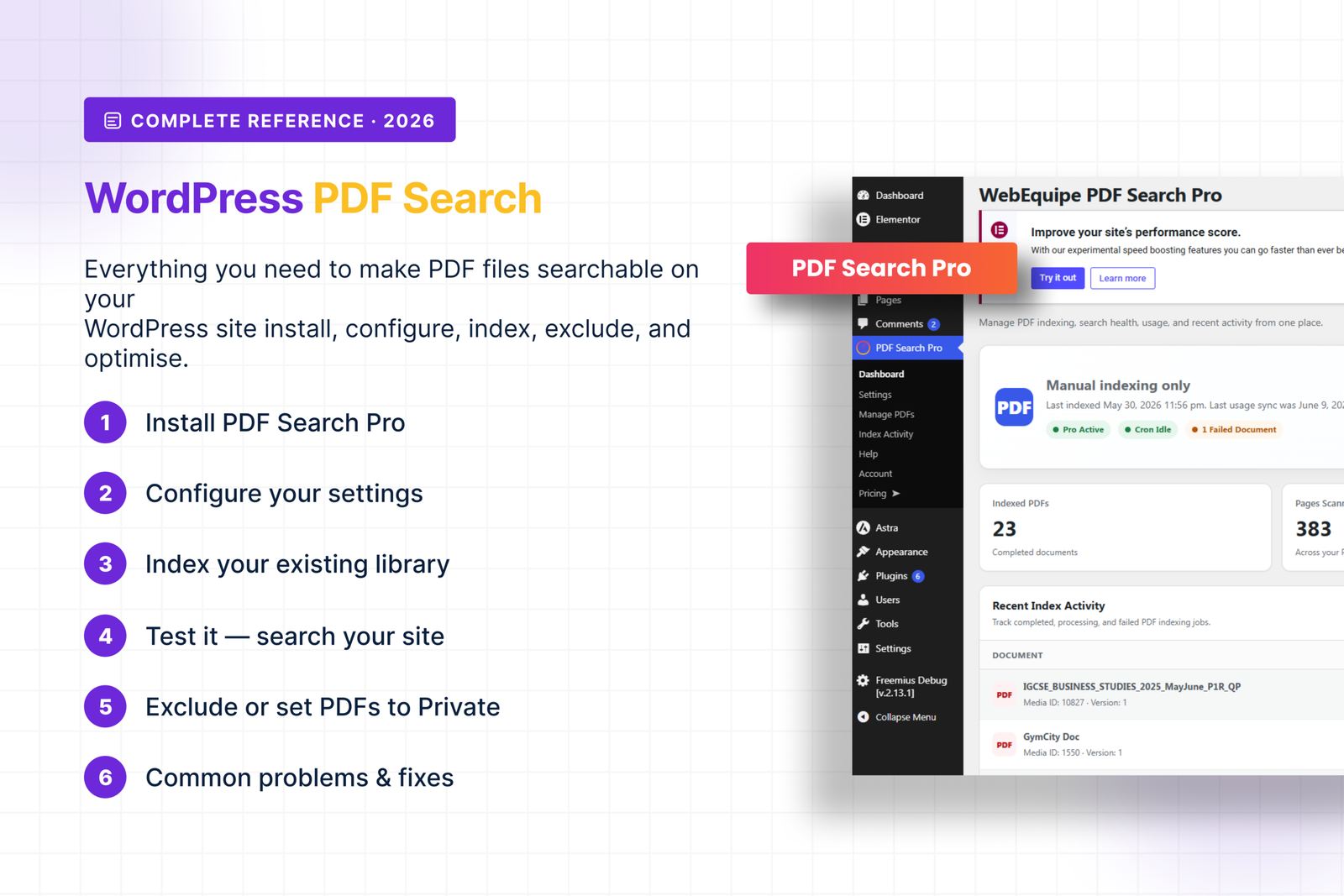
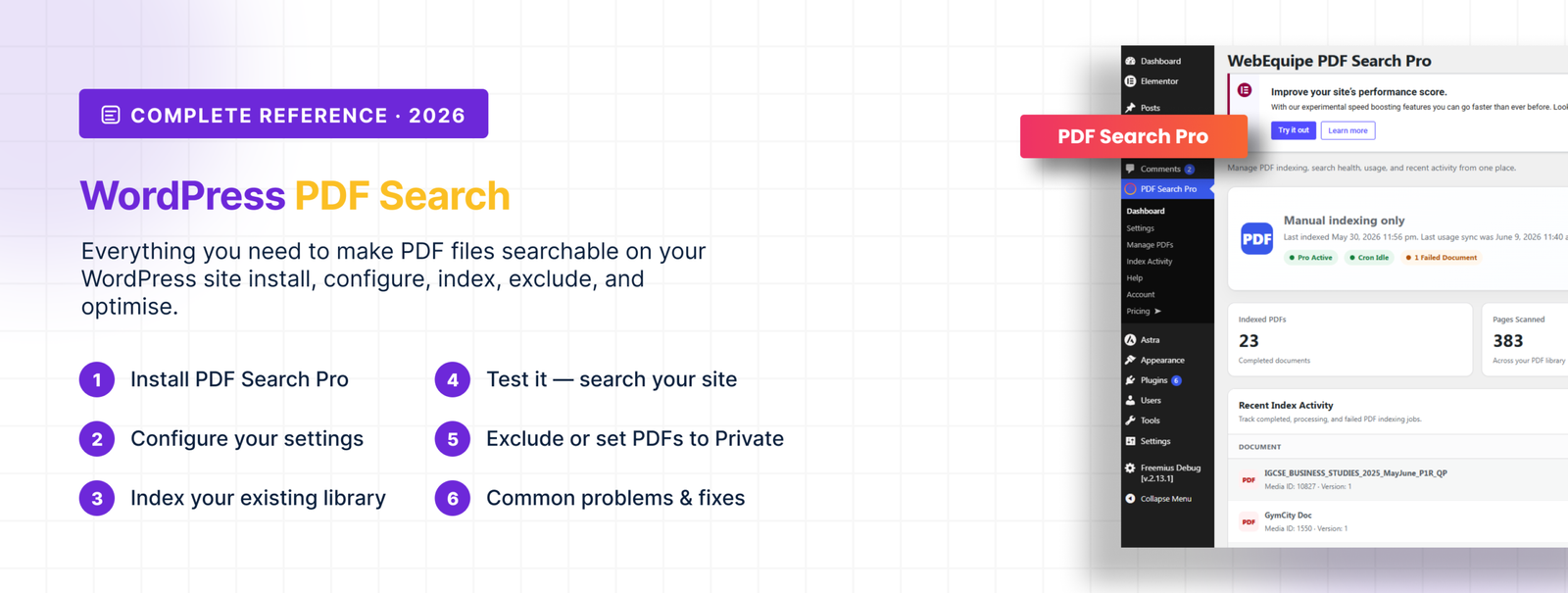
Step 1 — Install WebEquipe PDF Search

Go to Plugins → Add New in your WordPress dashboard. Search for WebEquipe PDF Search. Install it and activate it.

Once it’s active, you’ll see a PDF Search item in your WordPress admin sidebar.

Step 2 — Check Your Settings

Head to PDF Search → Settings. You don’t need to change much here, but confirm two things:

  • Enable PDF Indexing is turned on — this makes sure new PDFs you upload get indexed automatically going forward.
  • Enable Search Integration is turned on — this is what makes PDFs show up alongside posts and pages in your site’s normal search results.

If you’d rather keep PDF results separate from your posts and pages, you can leave Search Integration off and use the shortcode instead (Step 5).

Step 3 — Index Your Existing PDFs

The plugin won’t automatically pick up PDFs you’ve already uploaded. You need to run indexing once for your existing library.

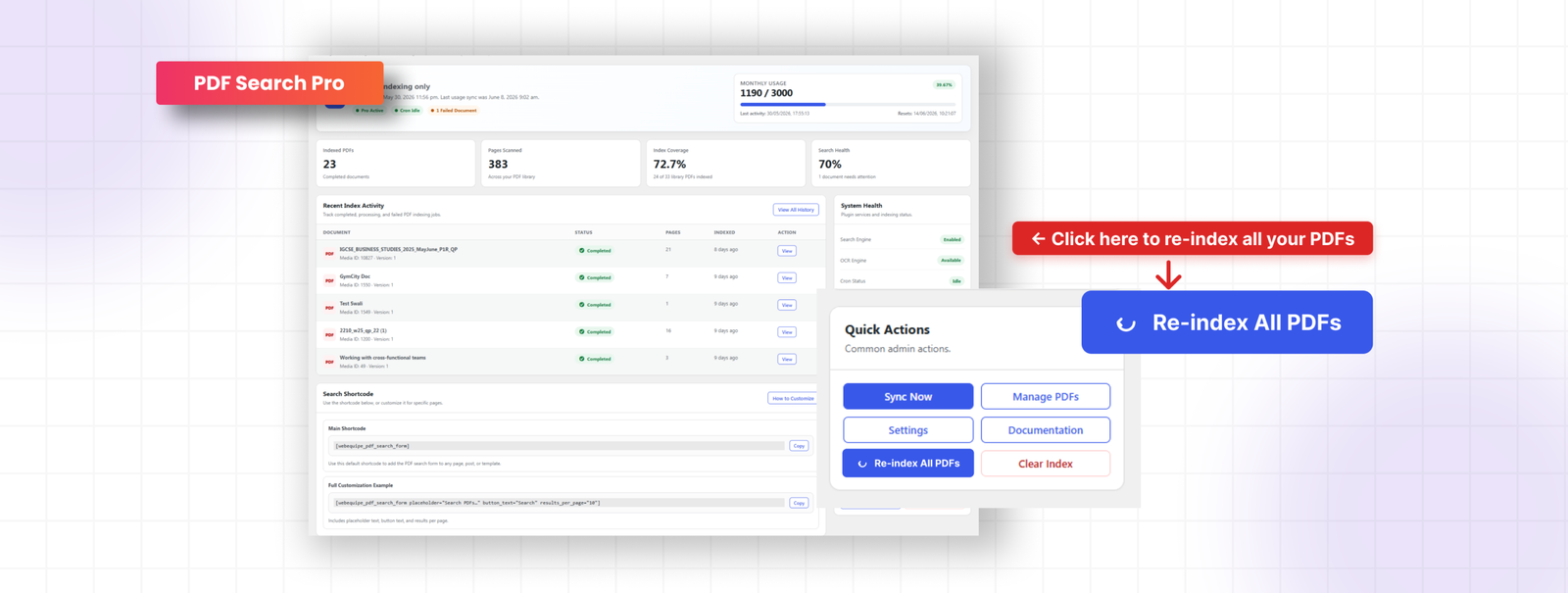
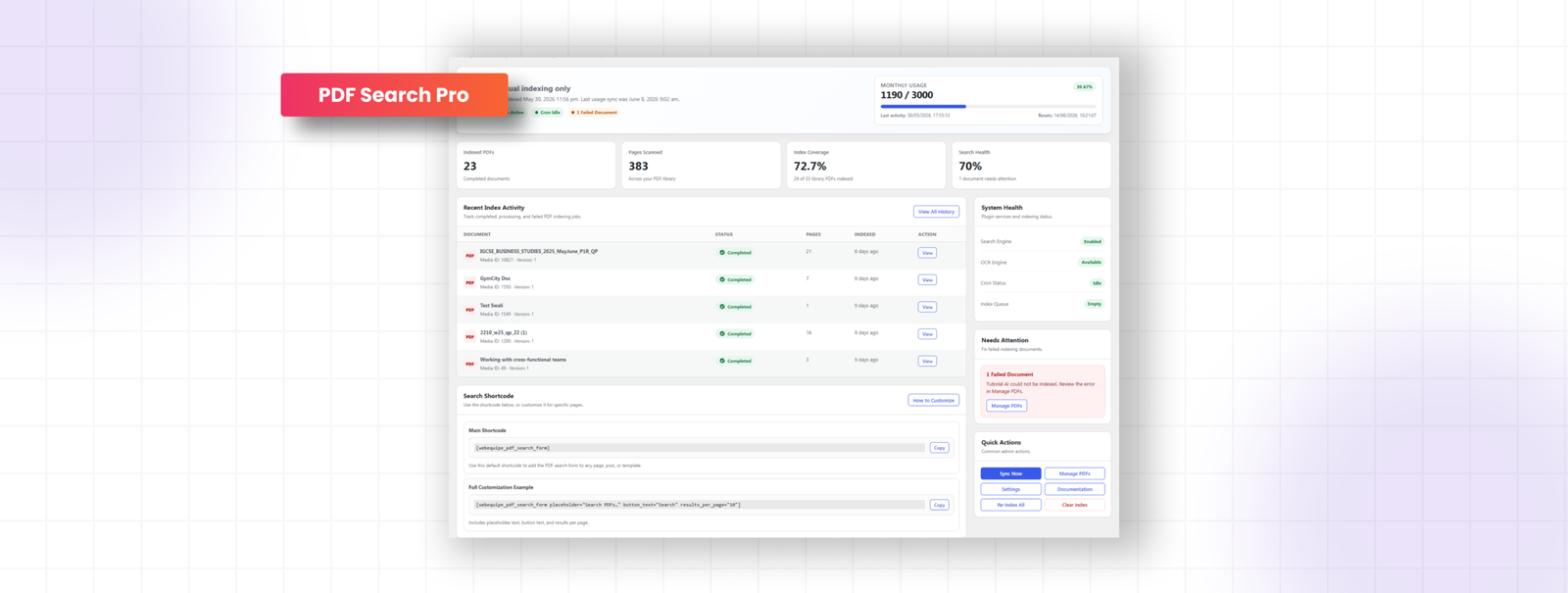
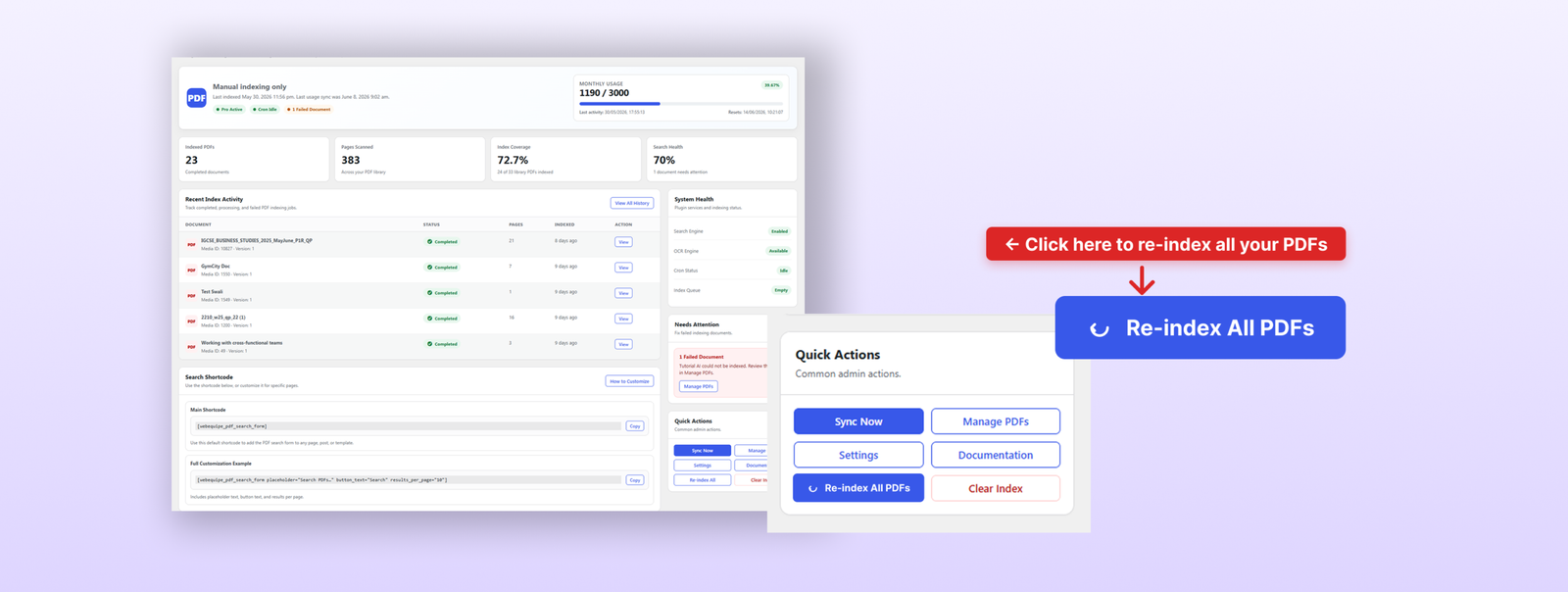
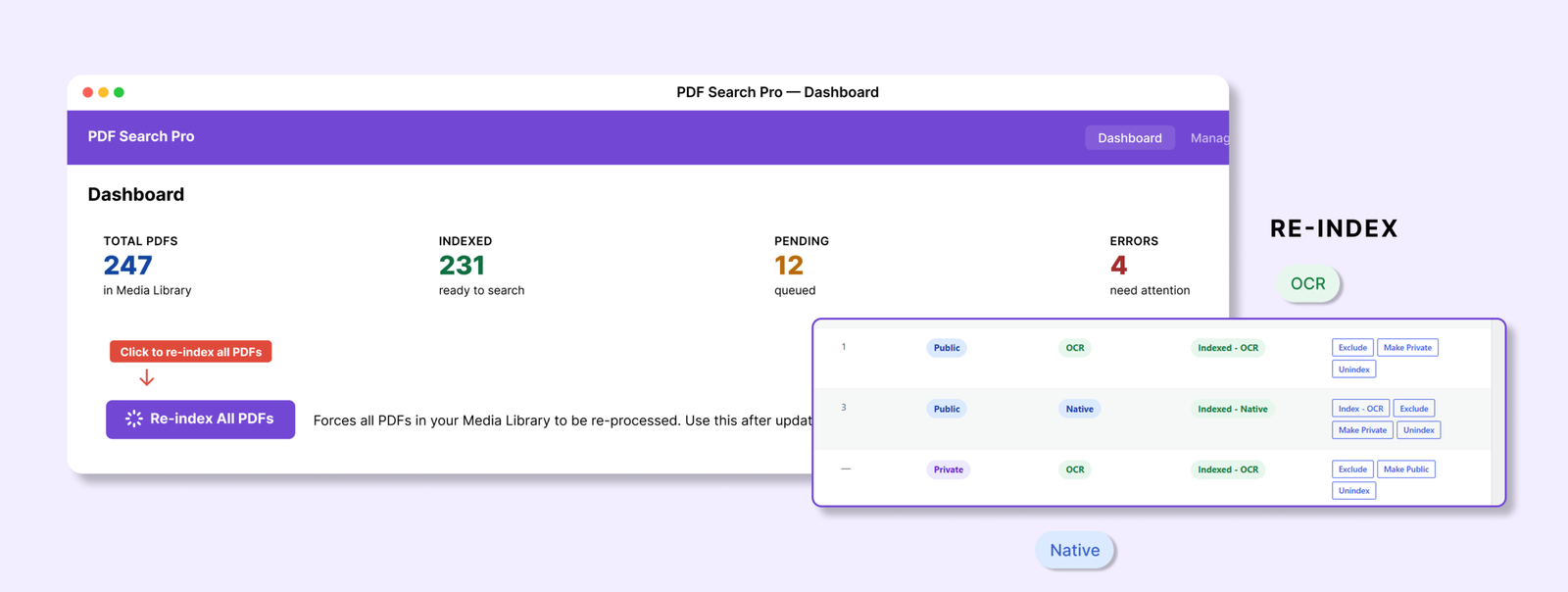
Go to PDF Search → Dashboard and click Re-index All PDFs.

The plugin will work through every PDF in your Media Library and extract the text. For a large library this runs in batches in the background — you can leave it and come back. Check the progress in PDF Search → Index Activity.

Step 4 — Test It

Once indexing is done, search for a word or phrase you know appears inside one of your PDFs.

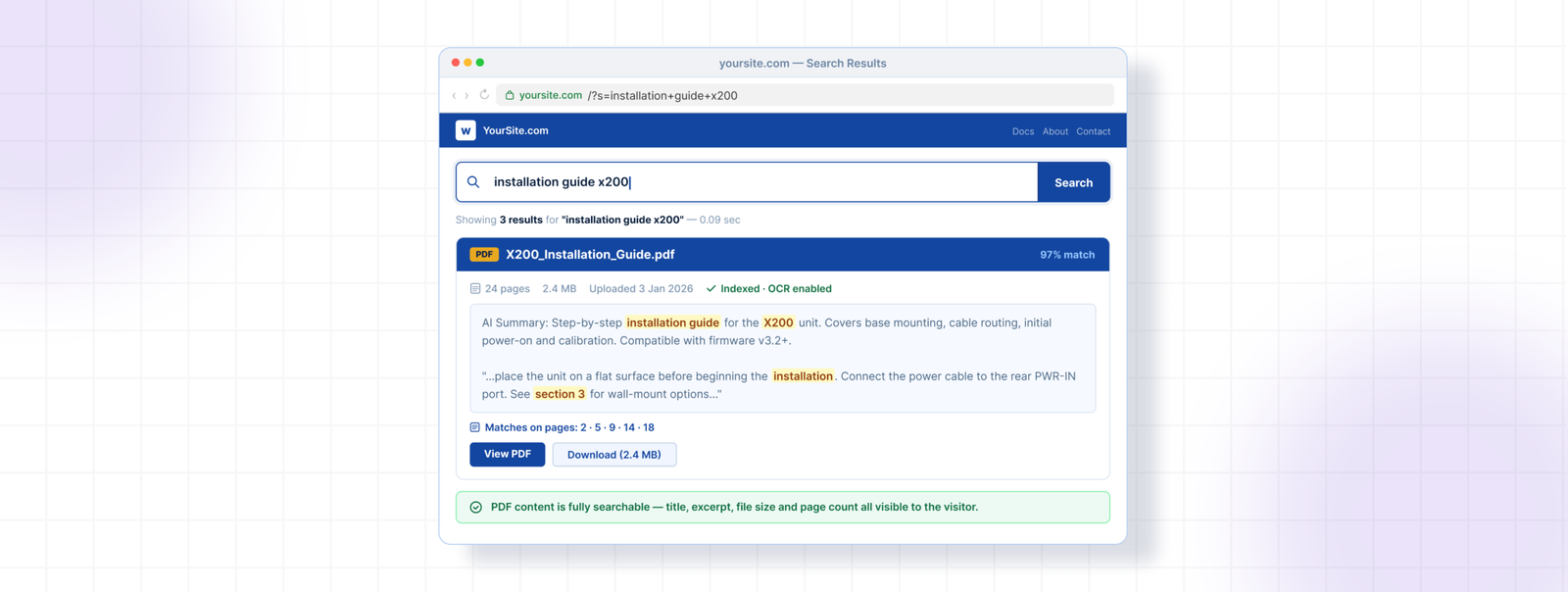
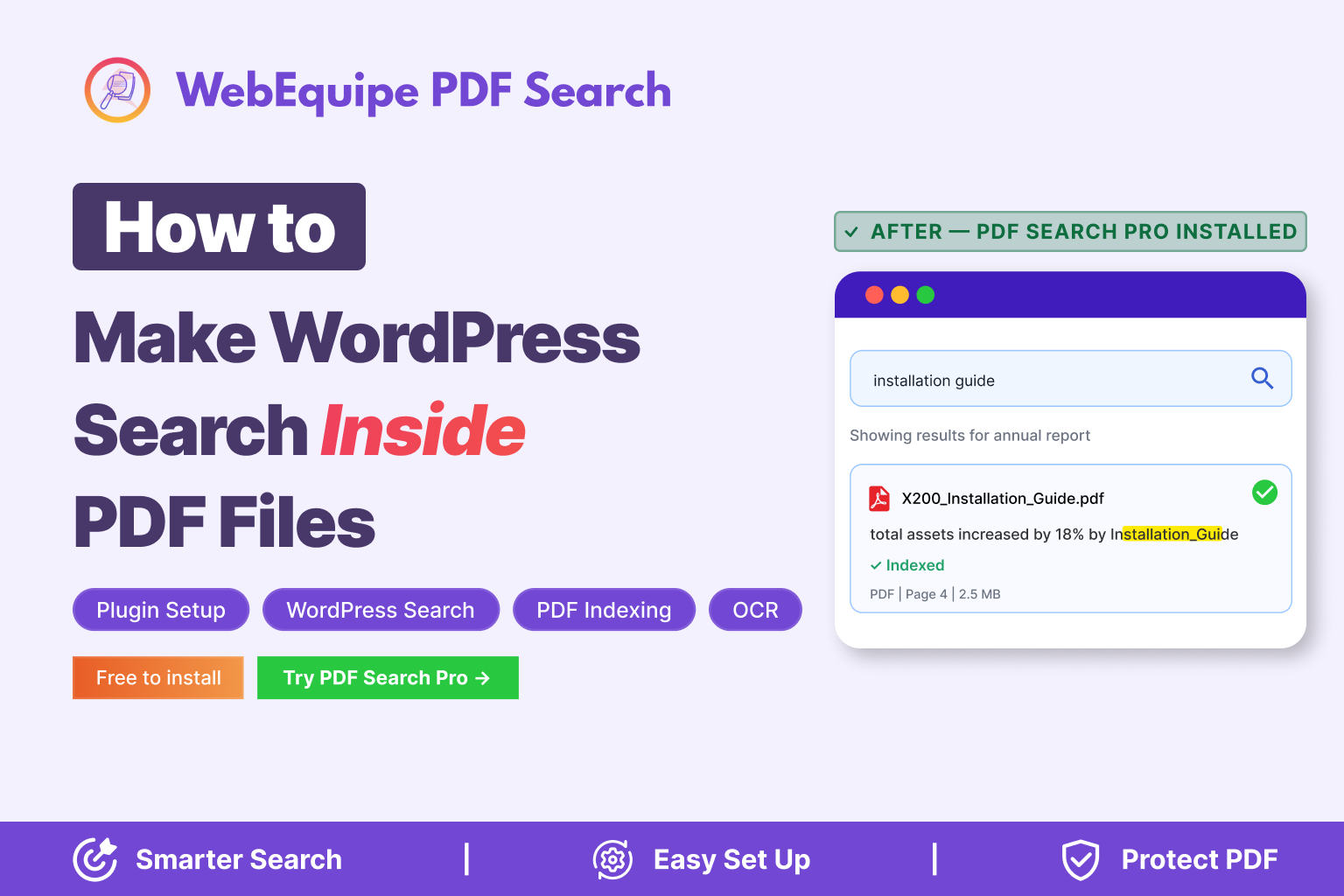
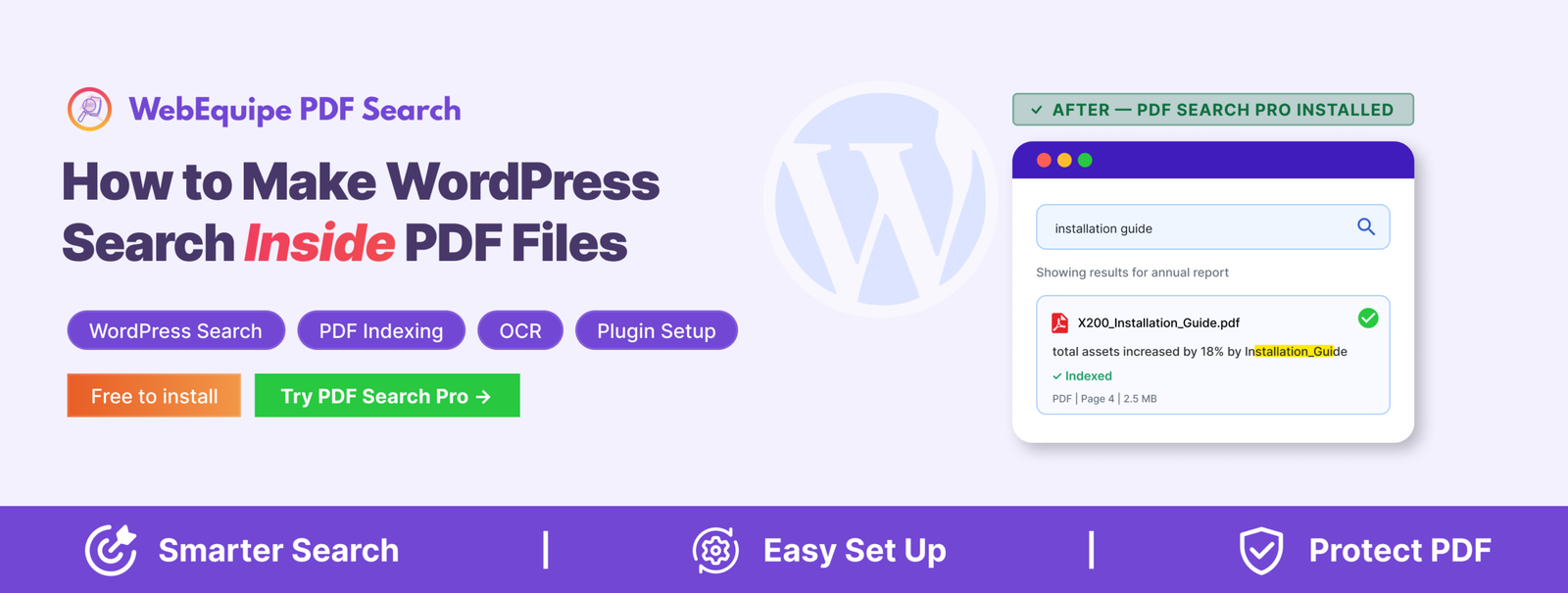
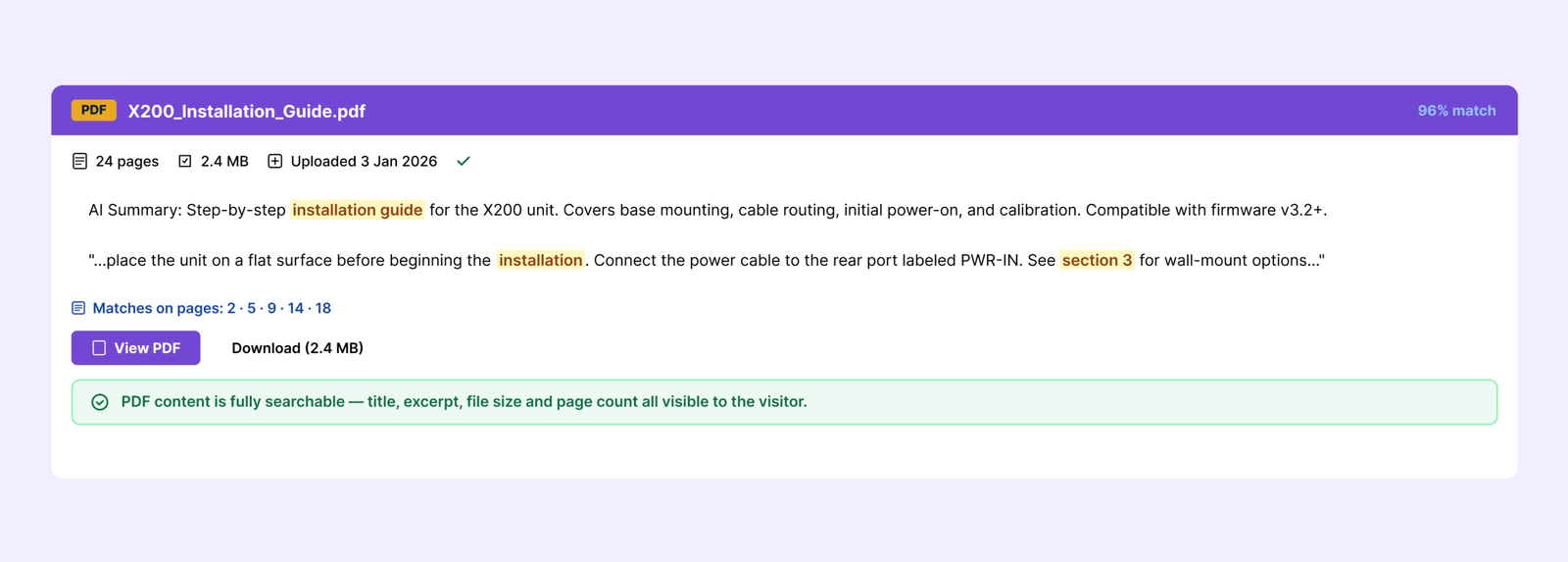
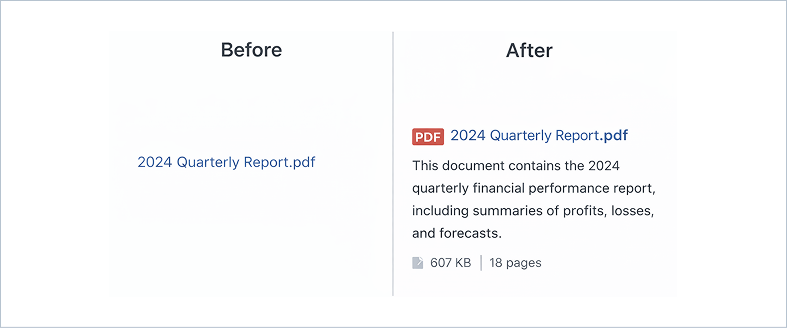
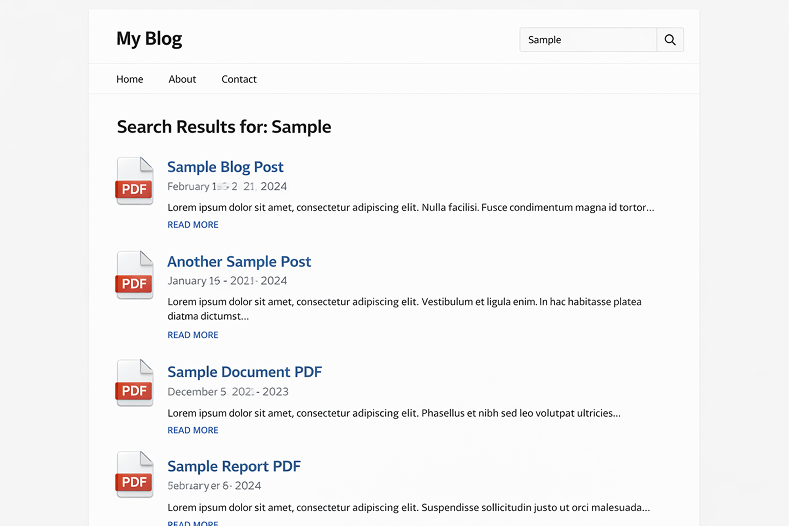
It should now appear in results — with the PDF title, a short excerpt from the matching page, and basic file details like size and page count.

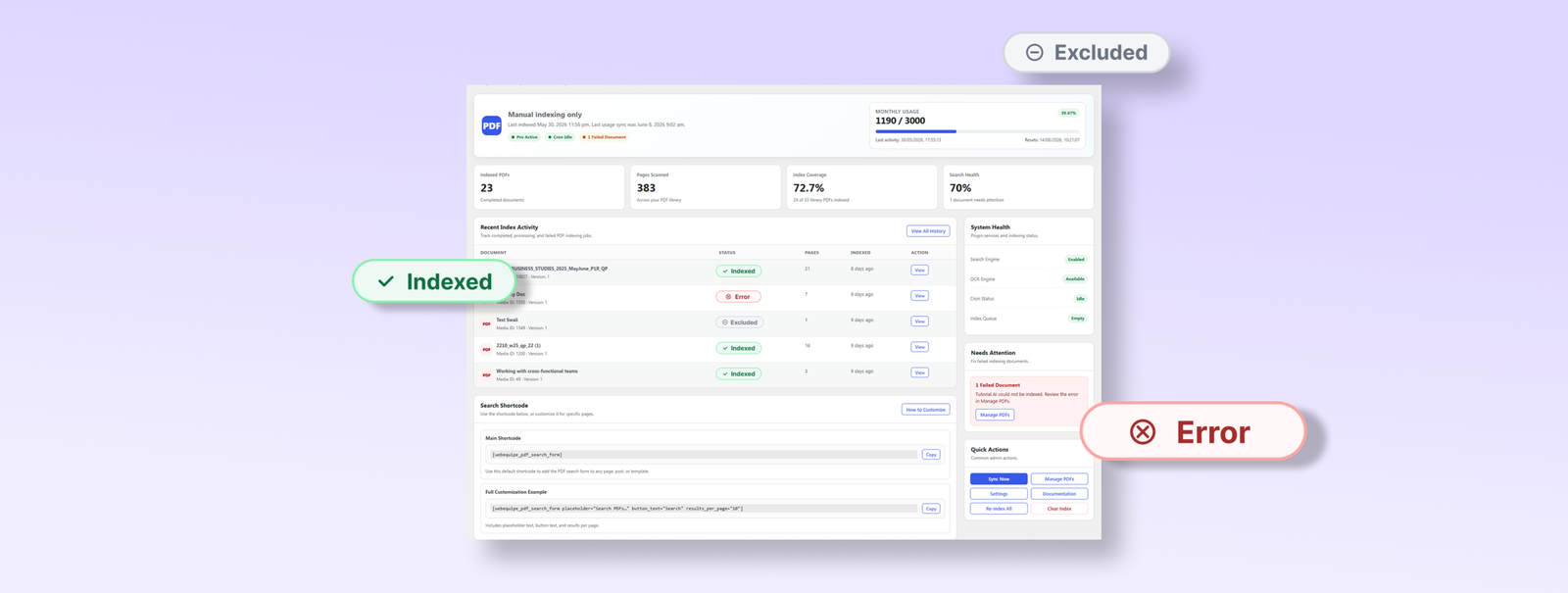
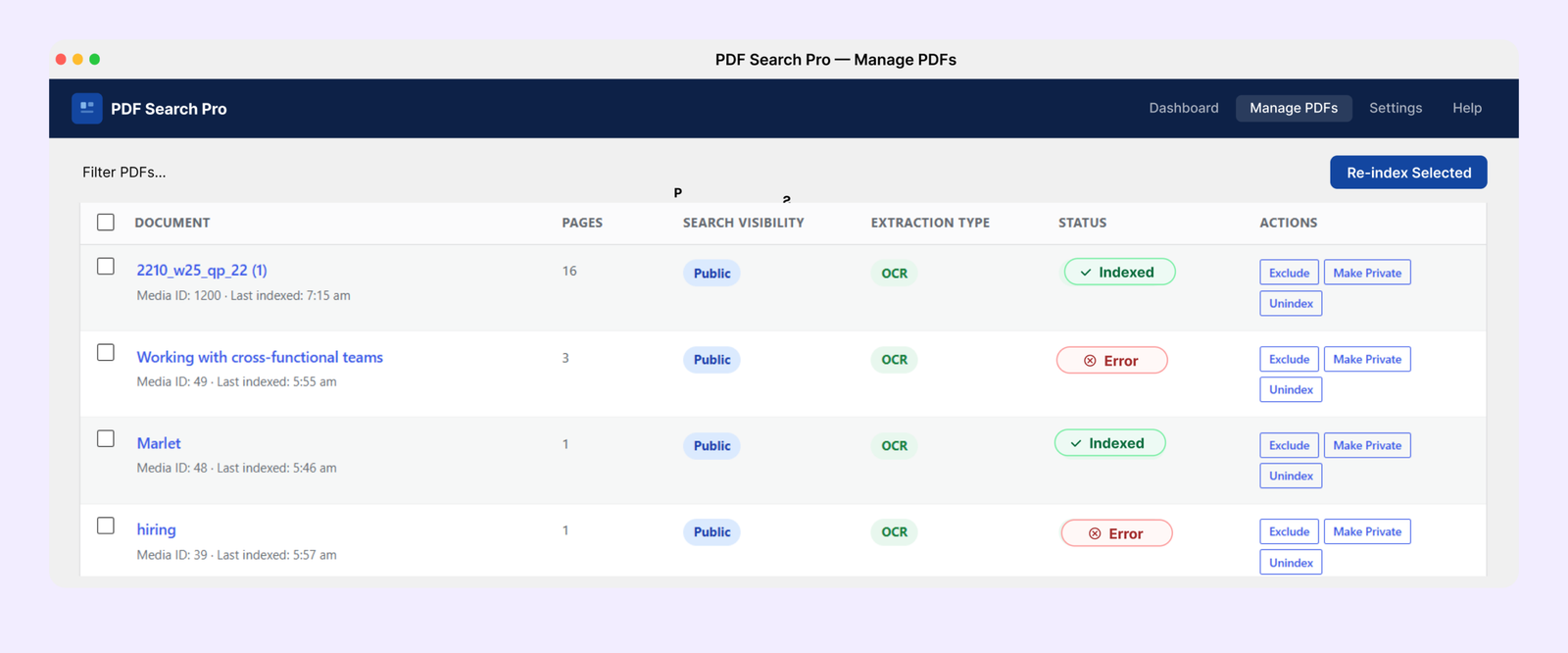
If a PDF isn’t showing up, go to PDF Search → Manage PDFs and check its status. Anything showing as Error or Not Indexed needs attention — the status badge tells you exactly why.

Step 5 — Add a PDF-Only Search Form (Optional)

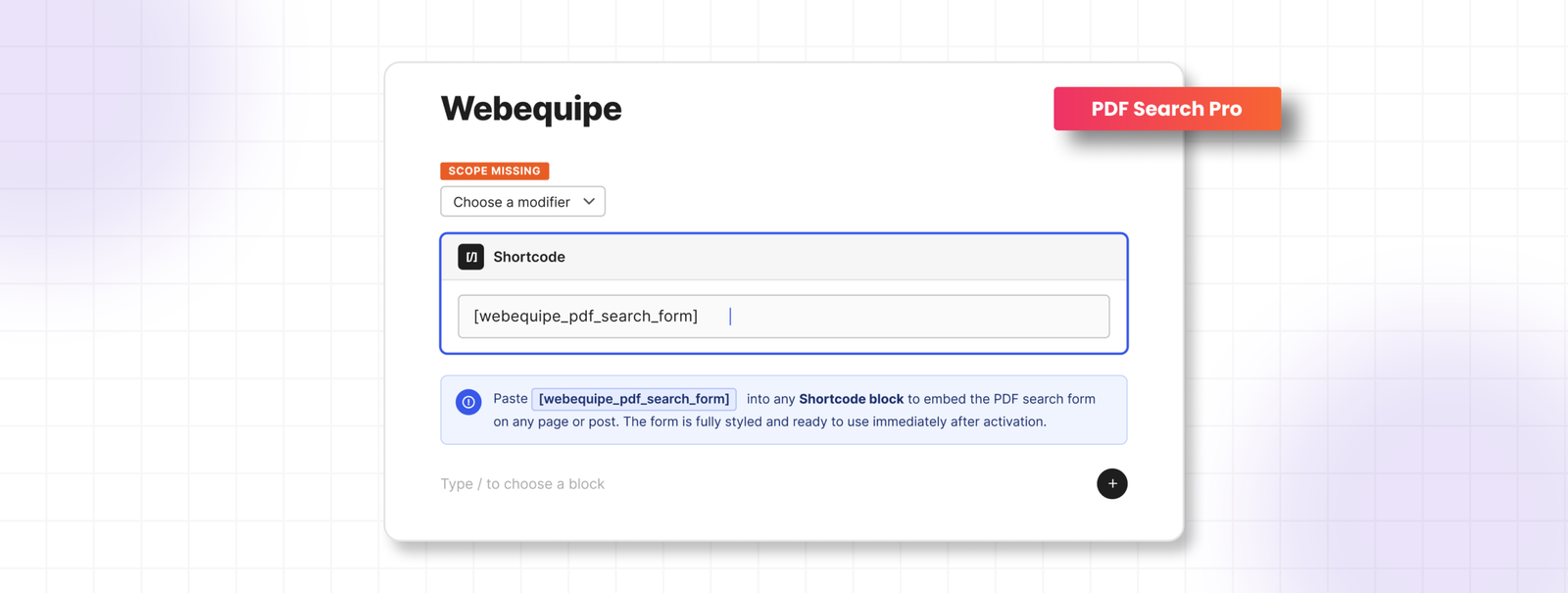
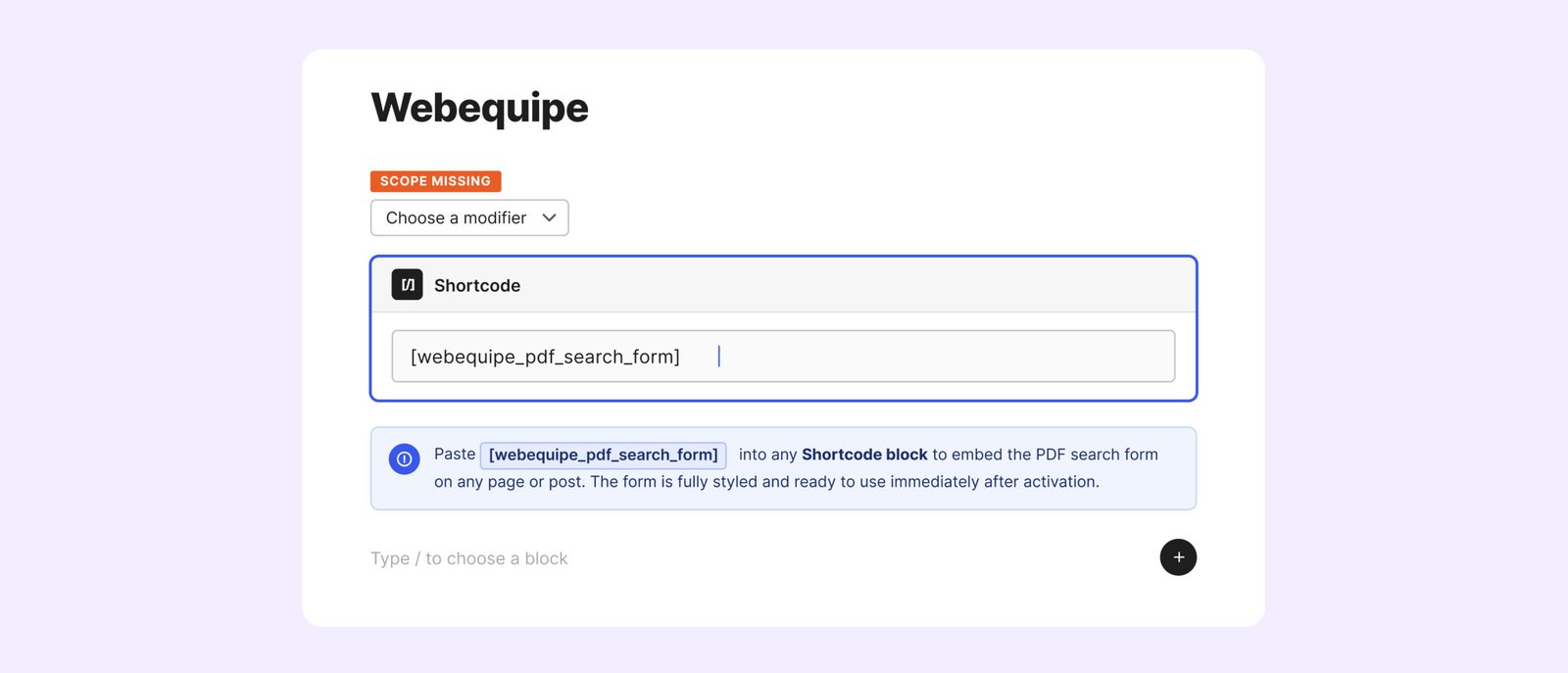
If you want a dedicated search box that only searches your PDFs — useful for help centres, resource libraries, or document portals — add this shortcode to any page:

Visitors get a search box that only looks at your PDFs — nothing else on the site, just the documents.

Soft CTA

The free plugin covers everything above at no cost. If you’re dealing with scanned documents or need to restrict certain PDFs to logged-in users only, that’s what PDF Search Pro is built for.

Best Practices

Filenames become titles. In search results, the PDF’s filename is what gets displayed as the title. annual-report-2025.pdf is a lot more useful than doc-final-v2-FINAL.pdf. It’s worth cleaning up filenames before you index.

The index doesn’t update automatically when you replace a file. If you swap out a PDF for a newer version, you need to manually re-index that file. Go to it in your Media Library and click Re-index.

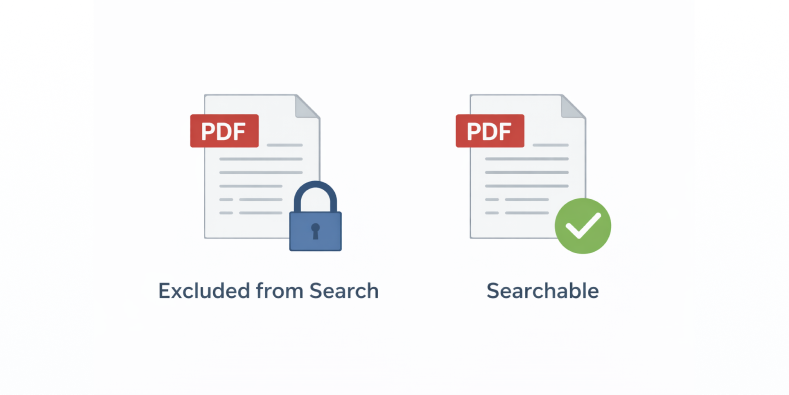
Use Exclude for PDFs that shouldn’t be searchable. Draft documents, internal files, outdated versions — use the Exclude option on these. The file stays in your Media Library, it just won’t be indexed or show up in any search results.

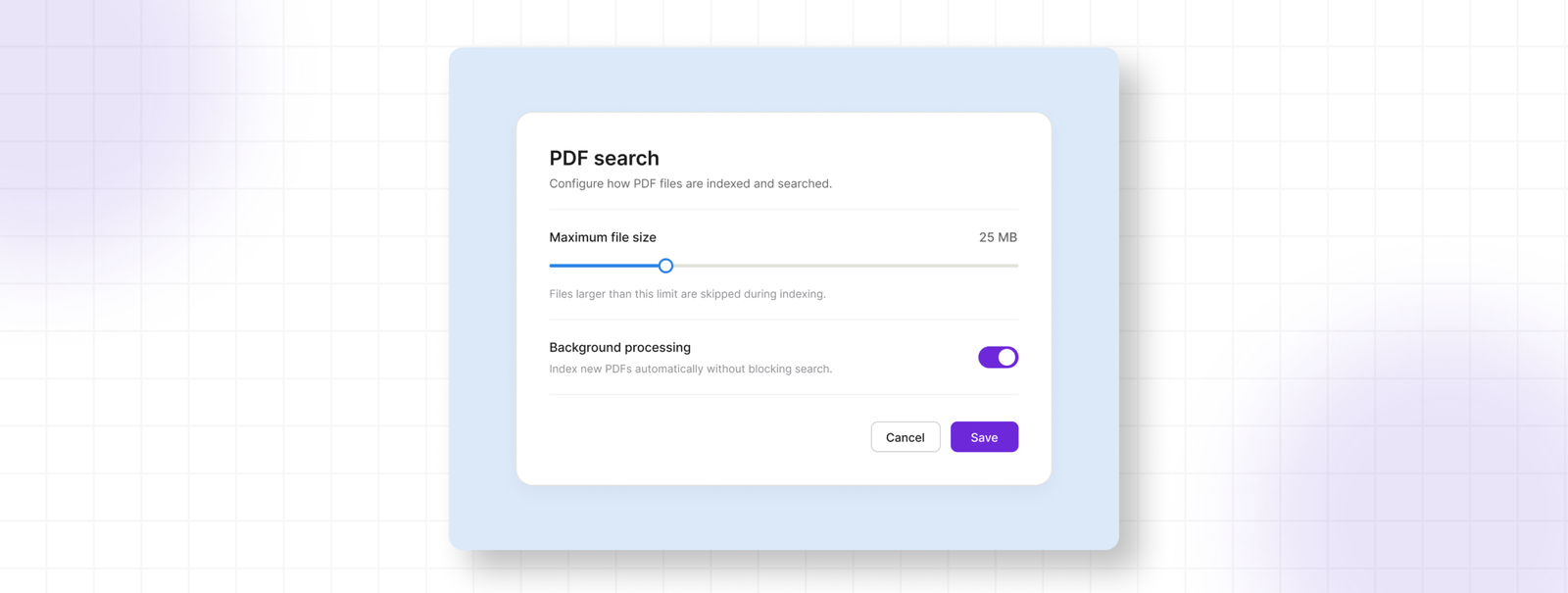
Large files take longer. The default size limit is 50MB. You can raise this in settings up to 500MB. Very large PDFs are processed in background batches automatically so they don’t time out.

Common Problems and How to Fix Them

PDFs still aren’t showing up after indexing

Check that Enable Search Integration is on in PDF Search → Settings. Also confirm the specific PDF isn’t set to Excluded.

Indexing keeps stopping or timing out

Go to PDF Search → Settings → Advanced and turn on Background Processing. This moves indexing out of the browser and into a background queue so it doesn’t need to finish in a single page load.
Some PDFs index fine but others show Error

This almost always means those PDFs are scanned — image-only files with no text layer. The free plugin can’t read them. You’ll need OCR for those.

PDFs show in results but with no excerpt

Usually means the text extraction returned very little content. Try opening the PDF and selecting some text. If you can’t highlight anything, it’s likely a scanned file.

When the Free Plugin Isn’t Enough

The free plugin handles text-based PDFs well. But two situations need the Pro version.

You have scanned PDFs

Archived reports, meeting minutes, old handbooks, government forms — these are all image-only files. The free plugin marks them as Error because there’s no text to extract.

WebEquipe PDF Search Pro includes OCR powered by Google Vision. Turn it on and scanned PDFs get processed automatically when you upload them — the text gets pulled from the images and indexed the same way a normal PDF would be. Nothing extra to set up on your end.
How to Make Scanned PDFs Searchable on WordPress →

You need some PDFs visible only to logged-in users

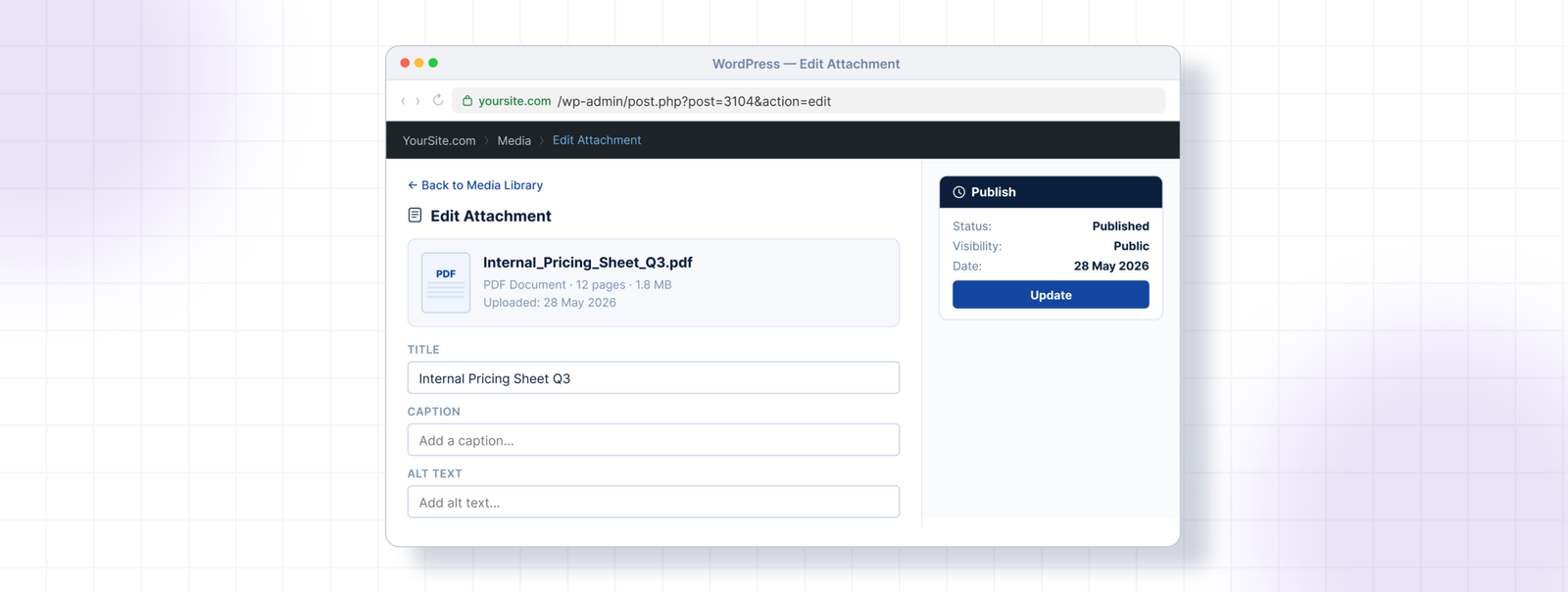
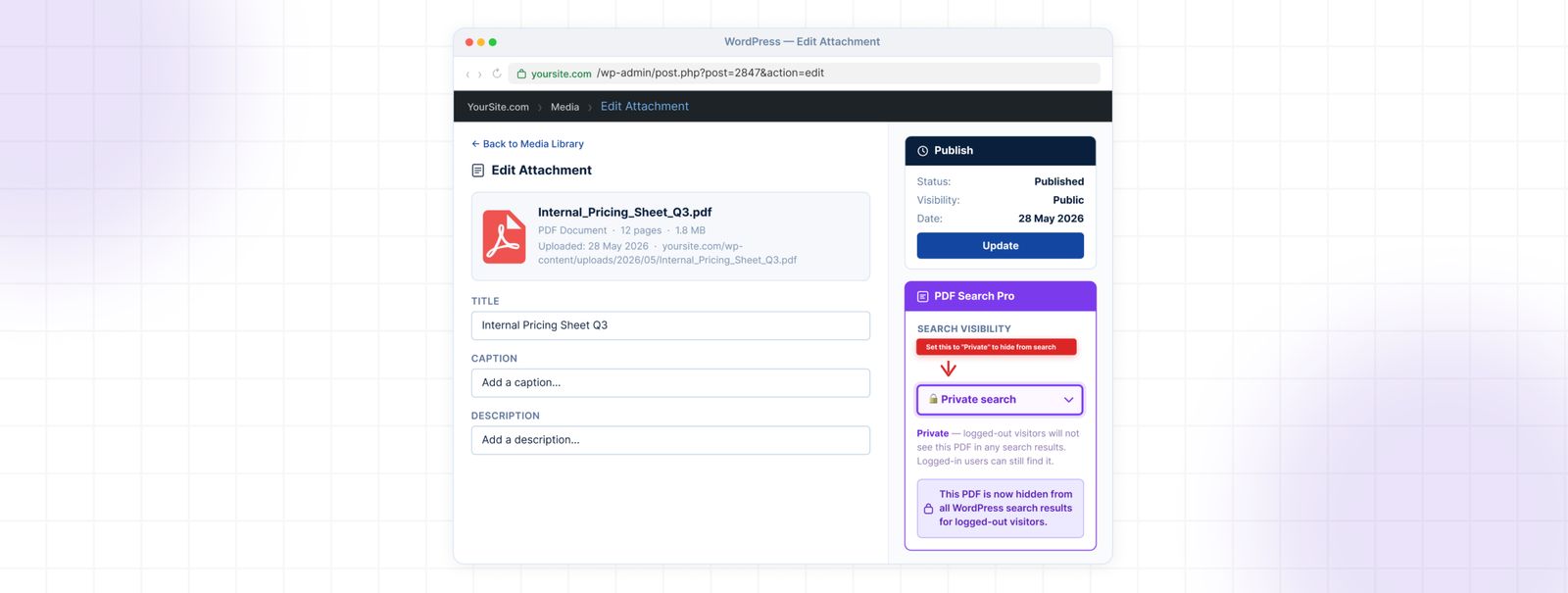
The free plugin’s Exclude feature removes a PDF from search entirely. But sometimes you want a document findable — just not by everyone. Member handbooks, staff policies, client resources.

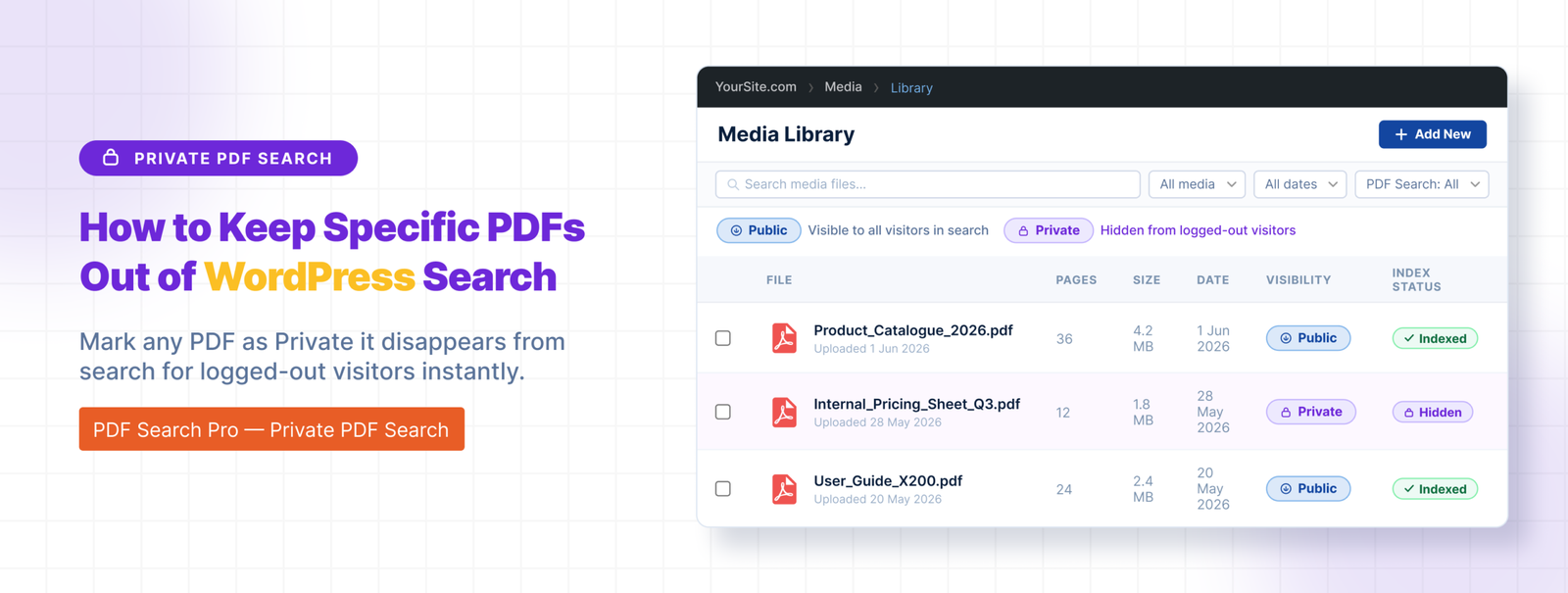
Private PDF Search (available on Pro and Agency plans) lets you mark individual PDFs as Private. They stay indexed but disappear from results for anyone who isn’t logged in. Logged-in users find them normally.

Frequently Asked Questions

Does WordPress search inside PDFs by default?

No — and this surprises a lot of people. WordPress only searches content you’ve typed directly into posts and pages. PDF files are stored as attachments. WordPress knows the filename exists but has never looked inside it. That’s what the plugin fixes.

Will this slow down my site?

Not in any noticeable way. Indexing happens in the background, either when a PDF is uploaded or when you manually kick it off. When someone searches, the query runs against the stored index — not the original files. Your visitors won’t feel a thing.

What about PDFs I’ve already uploaded?

Those won’t be picked up automatically. You run Re-index All PDFs once from the Dashboard after installing the plugin and it processes everything in your library. New uploads after that are handled automatically.

Can it handle password-protected PDFs?

No. If a PDF is locked, the plugin can’t get to the text inside it. Those files need to be unlocked before they can be indexed.

How many PDFs can it handle?

No hard limit. We’ve seen it work fine on sites with several hundred PDFs. Large libraries just run in batches so nothing times out.

Does it work with my theme?

Yes. It plugs into WordPress’s native search, so any theme using standard WordPress search will show PDF results. The shortcode form works independently of your theme entirely.

Getting Your PDFs Into Search

If your site has text-based PDFs, you’re ten minutes away from having them fully searchable. Install the free plugin, run Re-index All PDFs once, and your documents will start showing up in results straight away.

If you’re dealing with scanned files or need to keep certain documents restricted to logged-in users, that’s exactly what PDF Search Pro is built for.

View WebEquipe PDF Search plans →

Why Your WordPress Search Can’t Find Your PDFs (And It’s Costing You Visitors)

Why Your WordPress Search Can't Find Your PDFs (And It's Costing You Visitors)

You know that feeling, right?
A visitor emails you: “Hey, I can’t find your pricing guide on your website.”
You pause. Because you know it’s there. You uploaded it yourself three weeks ago. It’s a beautiful 12-page PDF sitting right in your Media Library.
So you go to your own site and search for it.
Nothing.
You try different keywords. Still nothing. You end up manually digging through your Media Library, finding the file, and sending them the direct link.
Here’s the thing that’ll really annoy you: WordPress search completely ignores what’s inside your PDF files.


The Problem Nobody Talks About

WordPress has fantastic search functionality. It can find a single word buried in a blog post from 2019. It’ll surface that random product description you wrote at 2am. It’s actually pretty impressive.
But PDFs? Nope. WordPress looks at the filename and stops there.
So if you named your file something like final – version – 2 – UPDATED. pdf (we’ve all done it), good luck having anyone find it through search.


The Problem Nobody Talks About search

Think about what this actually means for your site:
If you run a documentation site, your users are searching for answers that are literally on your website—they just can’t find them.
If you’re a school or university, students are looking for syllabi, assignment guides, or course materials that exist but are invisible to search.
If you manage an internal knowledge base, your team is wasting time asking questions that have already been answered in those HR handbooks, policy documents, or training guides you uploaded.
The content is there. The answers exist. But it’s like having a library where none of the books are in the catalog.


Why This Happens (The Boring Technical Bit)

Here’s what’s going on under the hood:
WordPress search works by indexing text content from your posts, pages, and custom post types. When you hit that search button, it’s looking through a database of actual words.
PDFs are files. Binary data. WordPress sees them the same way it sees image files—as attachments with metadata (filename, upload date, etc.) but not as searchable content.
To actually search inside a PDF, something needs to:

  1. Extract the text from the PDF file
  2. Store that text somewhere searchable
  3. Include it in search results
  4. Show relevant excerpts so people know what they’re clicking on

WordPress doesn’t do this out of the box. And honestly, why would it? Not everyone uploads PDFs. It’s not a universal need.
But if you do upload PDFs—especially lots of them—this is a massive blind spot.

Why This Happens (The Boring Technical Bit) in WordPress

What People Usually Try (And Why It Doesn’t Really Work)

When you first discover this problem, the solutions seem obvious:
“I’ll just rename my files with better keywords!”
Okay, but that only helps if someone searches for those exact words in the filename. And you can’t fit much information into a filename before it gets ridiculous: employee-handbook-2024-vacation-policy-sick-leave-benefits-insurance-401k.pdf
“I’ll add descriptions in the Media Library!”
Some themes and plugins let you add descriptions to media files. Great! Except… most WordPress search implementations don’t actually search media descriptions. You’re basically adding metadata that nothing reads.
“I’ll just create posts and link to the PDFs!”
This works! But now you’re maintaining duplicate content. Every time you update a PDF, you need to remember to update the corresponding post. Plus, you’re adding extra clicks—people have to find the post, then click through to the PDF.

None of these are actual solutions. They’re workarounds.

What People Usually Try (And Why It Doesn't Really Work)

What Actually Works: Making PDFs Searchable

The real solution is extracting the text content from your PDFs and making it searchable, just like your blog posts.
Here’s what that looks like in practice:
When someone uploads a PDF, the system automatically:

  • Opens the PDF and extracts all the readable text
  • Stores that text in your database
  • Indexes it for search (just like post content)
  • Links it back to the original PDF file

Then when someone searches your site:

  • They get results from posts, pages, and PDFs
  • Search results show actual excerpts from inside the PDF
  • They can see if it’s relevant before downloading
  • Everything works through your normal WordPress search

No manual work. No duplicate content. No remembering to update things.

What Actually Works: Making PDFs Searchable - WordPress media

The Privacy Question Nobody Asks (But Should)

Here’s something most people don’t think about until it’s too late:
What about PDFs you don’t want people to find through search?
Maybe you have:

  • Internal financial documents that are uploaded but should stay private
  • Draft versions of public documents
  • Sensitive HR files
  • Client work that’s not meant to be discoverable

If you’re indexing everything, you need a way to exclude specific files.
This is where most “solutions” fall short. They’re all-or-nothing. Either everything’s searchable or nothing is.
What you actually need is control: “Index this, but not that. And if I re-index everything later, still skip the ones I marked as private.”

The Privacy Question Nobody Asks (But Should) searchable

What This Looks Like for Real Sites

Let me give you a real scenario:
A university department has 200+ PDFs on their site:

  • Course syllabi
  • Assignment guidelines
  • Reading lists
  • Research papers
  • Administrative forms

Before making PDFs searchable: Students email the department assistant 15-20 times per week asking where to find documents. The assistant spends hours responding with direct links.
After making PDFs searchable: Students find what they need through site search. Email requests drop to 2-3 per week (and those are usually for things that genuinely don’t exist on the site yet).
The content didn’t change. The documents were always there. The only difference is that now they’re findable.

What This Looks Like for Real Sites

The Setup (Easier Than You Think)

Here’s what you’d need to do to make this work:

  1. Install a PDF search solution – Something that handles the text extraction and indexing automatically
  2. Run initial indexing – Process your existing PDFs (one-time thing)
  3. Set exclusions – Mark any private PDFs that shouldn’t be searchable
  4. Done – New PDFs get indexed automatically on upload

That’s it. No ongoing maintenance. No manual updates.
The whole setup takes maybe 5 minutes. The initial indexing depends on how many PDFs you have, but it runs in the background—you can just let it do its thing.

The Setup (Easier Than You Think) My blog

Things to Look For in a Solution

If you’re evaluating options, here’s what matters:
Automatic indexing – You don’t want to manually trigger indexing every time you upload a file. It should just happen.
Exclusion controls – You need to be able to mark specific PDFs as “don’t index this” and have that setting stick even during bulk re-indexing.
Search integration – PDF results should appear in your normal WordPress search, not in some separate search interface.
Background processing – Large PDFs (50MB+) should be processed in the background so they don’t slow down your site or timeout.
File size support – Some solutions cap out at 10-20MB. If you have larger technical documents or image-heavy PDFs, you need something that handles bigger files.
Actual content extraction – This should go without saying, but the solution needs to extract the actual text, not just index metadata. Some plugins claim to make PDFs “searchable” but really just make the filenames searchable.


The Bottom Line

If you have PDFs on your WordPress site, they should be searchable. Period.
It’s not a nice-to-have feature. It’s basic functionality. Your visitors expect it. Your content deserves to be found.
The good news? This isn’t a hard problem to solve anymore. You don’t need to hire a developer or mess with complicated code.
You just need the right tool for the job.

The Bottom Line for pdf search

Make Your PDFs Searchable Today

WebEquipe PDF Search is a free WordPress plugin that automatically indexes your PDF content and integrates it with your site’s search. Install it, click one button to index your existing PDFs, and you’re done. Your visitors will finally be able to find the documents they’re looking for.

Download free from WordPress.org →